Professional Information
The therapeutic effect of EYESIS IPL on children with vernal keratoconjunctiviti
2026-10-22
Dry eye
Vernal keratoconjunctivitis (VKC) is a chronic ocular inflammatory disease with a tendency for seasonal recurrence, involving the cornea and conjunctiva. It commonly occurs in children and adolescents, especially those under the age of ten. The main symptoms and signs include eye itching, foreign body sensation, increased secretions, conjunctival congestion, edema, palpebral conjunctival papillae hyperplasia, and Horner-Trantas nodules at the corneal limbus. The pathogenesis of VKC may involve genetics,endocrine factors, immune mediation, and environmental factors. Currently, the clinical treatment mainly consists of eye drops such as antihistamines, mast cell stabilizers, glucocorticoids, and immunosuppressants, with long treatment courses and inability to fundamentally prevent disease recurrence.A recent research shows that IPL is suitable as an adjuvant therapy method for children with recurrent VKC.
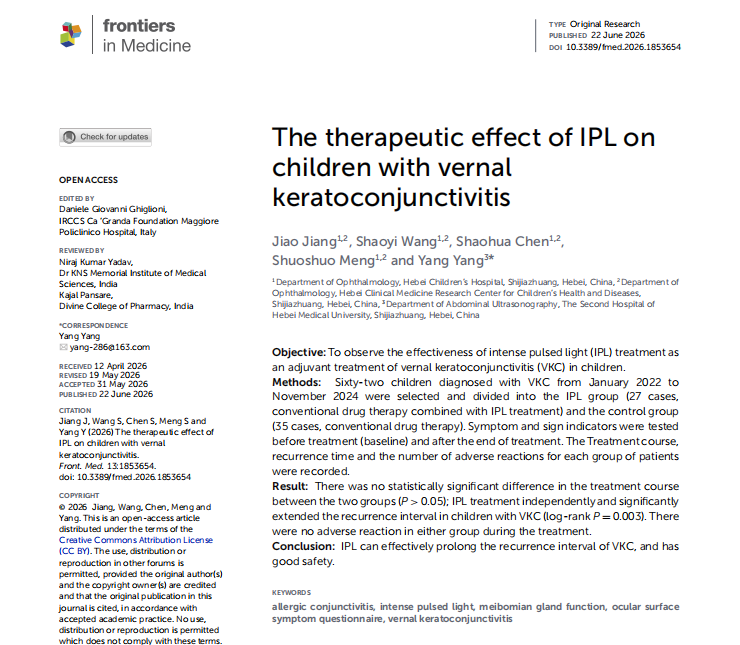
To observe the effectiveness of intense pulsed light (IPL) treatment as an adjuvant treatment of vernal keratoconjunctivitis (VKC) in children.
Materials
The study subjects were selected from patients diagnosed with VKC at the Ophthalmology Department of Hebei Children’s Hospital from January 2022 to November 2024. The patients had to have experienced at least three recurrences within the past 1 year.A total of 62 patients were included. Among them, 27 patients (IPL group) agreed and accepted conventional drug therapy combined with IPL treatment, and 35 patients (control group) received conventional drug therapy. Both groups selected the right eye as the research subject.
Inclusion criteria
(1) Children under the age of 15, with good compliance, and able to cooperate with all examinations and follow-ups;
(2) Meeting the diagnostic criteria for VKC (5);
(3) In the period of illness onset, with obvious subjective symptoms (itching, foreign body sensation, etc.);
(4) Recurrent at least three times within the past 1 year;
(5) No history of wearing contact lenses;
(6) No other inflammatory diseases or conditions that may cause dry eye or meibomian gland dysfunction;
(7) Normal intraocular pressure; (8)No autoimmune diseases.
Treatment method
1. Control group
Received conventional drug treatment. Eye drops included antihistamine drugs, mast cell stabilizers, glucocorticoids,immunosuppressants and artificial tears. According to the severity of the disease (Bonini scale), the drug treatment plan is as follows: mild-moderate (Grade 1–2): olopatadine hydrochloride 0.1% eye drops, 2×/day; sodium hyaluronate 0.3% artificial tears, 4×/day.Moderate-severe (Grade 3–4): above plus fluorometholone 0.1% eye drops, 2×/day (≤2 weeks); cyclosporine A 0.05% emulsion, 2×/day. All drugs used were of the same brand and dosage form in both groups.
2. IPL group
Conventional drug treatment combined with IPL treatment. For the IPL treatment of patients, the “EYESIS Light Pulse MOPT Meibomian Gland Dysfunction Treatment Instrument” was used. IPL energy was started at 8 J/cm² and increased stepwise by 0.5J/cm² up to a maximum of 12 J/cm² based on the child’s tolerance(no pain or mild warmth). The same physician (J. J.) performed all treatments to ensure consistency. The children were in a supine position, both eyes were covered with protective eye masks, and coupling agent was applied to the lower eyelid. The same physician held the treatment handle and used the fan-shaped irradiation method to perform IPL treatment from the lower eyelid nasal side to the temporal side. Each eye was irradiated five times. IPL treatment was received once a week for a total of three times.
Observation indicators
All patients were followed for a minimum of 12 months after recovery, with regular visits every 4 weeks. Visual acuity, intraocular pressure, slit-lamp examination and corneal fluorescein staining examination were performed at each follow-up visit.
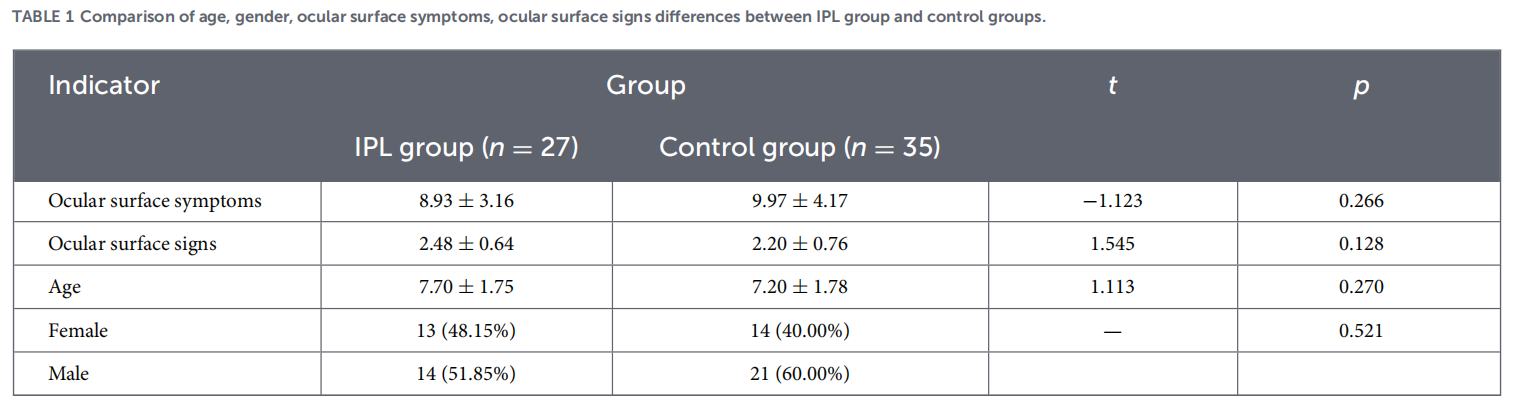
1、There was no statistically significant difference in age, gender, ocular surface symptoms score and ocular surface signs grade among IPL group and control group (P > 0.05), so they were comparable (Table 1).
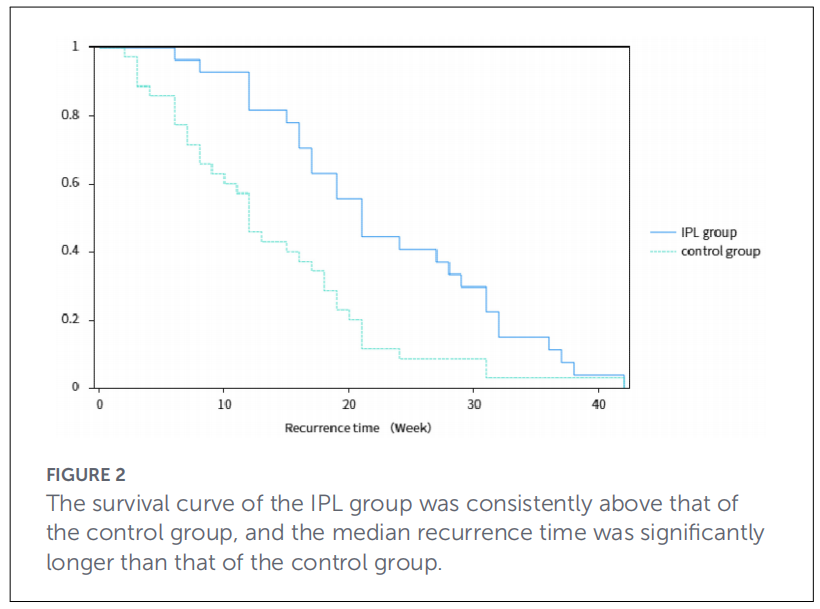
2、The median recurrence time was 21.00 weeks (95% CI: 16.00–29.00) in the IPL group and 12.00 weeks (95% CI: 8.00–17.00) in the control group. The log-rank test indicated a significant difference between the two groups (P = 0.003; Table 3, Figure 2).

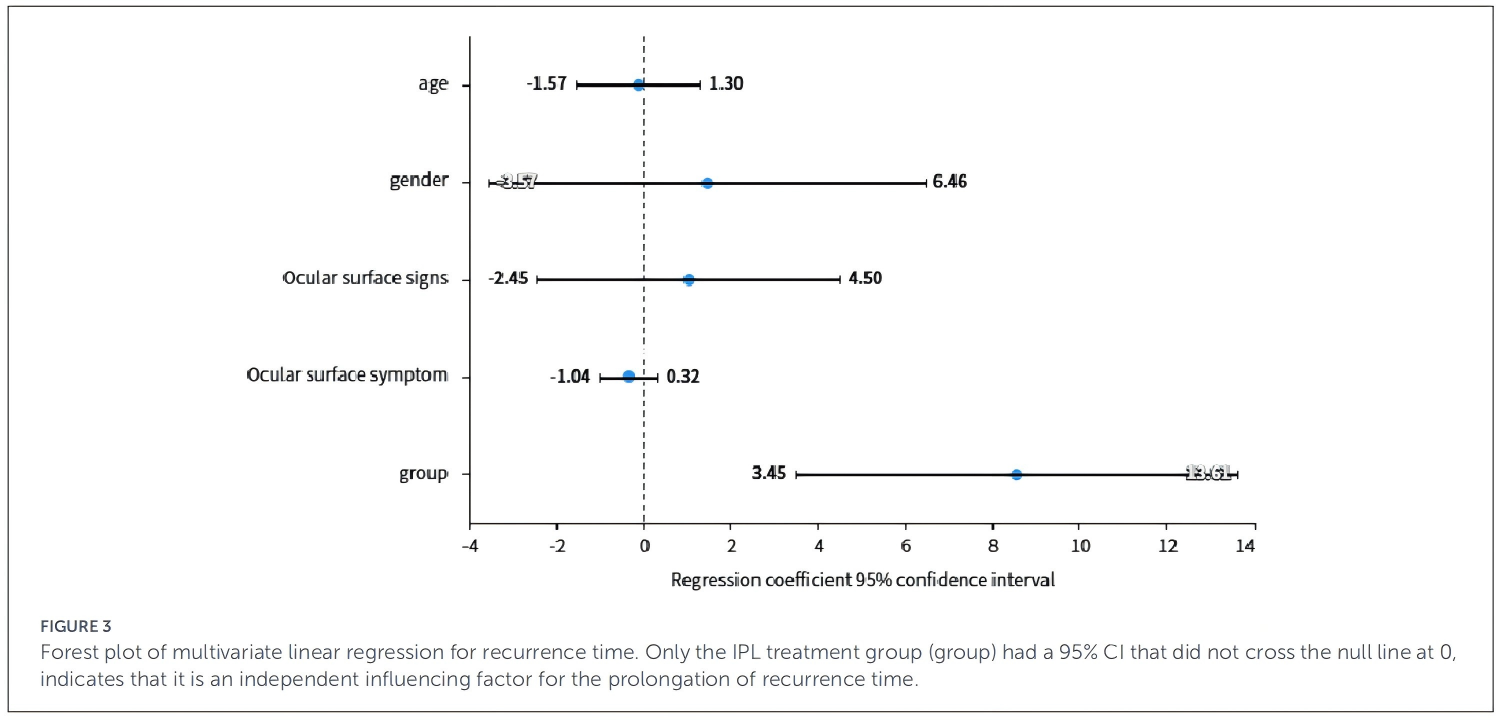
Multivariate linear regression demonstrated that IPL treatment was independently associated with a longer recurrence time (95%CI: 3.45–13.61, P = 0.003). Age, gender, baseline symptom score, and baseline sign grade had no significant effects on recurrence time(all P > 0.05; Figure 3).
The recurrent and persistent nature of VKC can lead to severe complications such as corneal neovascularization, scarring, keratoconus, and even steroid-induced glaucoma (7). Recent transcriptome profiling of conjunctival epithelial cells from VKC patients has provided molecular evidence of significant epithelial remodeling, although this remodeling does not appear to be mediated by epithelial-mesenchymal transition. The commonly used clinical treatment plans for VKC are eye drops as follows: mild cases are treated with histamine drugs/histamine receptor stabilizers, moderate to severe cases require the combination of glucocorticoids, and refractory or steroid-dependent cases need to add immunomodulators such as cyclosporine or tacrolimus. However, even with the above standardized treatment, VKC still has a significant tendency to recur, and some children even present with a perennial course of the disease. In our study, the average recurrence interval of the control group was 16.11 weeks, further suggesting that relying solely on conventional drugs is insufficient to ensure the long-term stability of the condition.
Our study found that the first recurrence interval for patients in the IPL combined treatment group was significantly longer than that of the drug-only group, suggesting that IPL can effectively prolong the remission period. The mechanism of action may be related to the following pathways: firstly, IPL can close abnormal dilated capillaries in the conjunctiva and the ocular surface through selective photothermal action. In VKC patients, there are a large number of new blood vessels and inflammatory cells (eosinophils,mast cells, lymphocytes) infiltrating the conjunctiva tissue, and these cells are the key cellular basis for the persistence and recurrence of inflammation. Secondly, IPL can inhibit the activation and release of various inflammatory factors in the ocular surface. A large number of studies have shown that the levels of Th2-type cytokines (IL-4, IL-5, IL-13), chemokines (CCL24, CCL11, CCL17), and eosinophil cationic protein (ECP) in the tear fluid of VKC patients are significantly increased. In addition, Li et al. found that IPL can significantly alleviate the oxidative stress response in perennial allergic conjunctivitis, and oxidative stress has been confirmed to be involved in the chronic inflammatory process of VKC.
In terms of the treatment course, there was no significant difference between the two groups of patients. The pathogenesis of VKC includes IgE-mediated immediate allergic reactions, as well as chronic inflammation dominated by Th2 cells, imbalance of oxidative stress, and damage to the ocular surface barrier function. Conventional anti-allergic drugs can only relieve the allergic symptoms during the acute phase and cannot repair the ocular surface barrier damage, improve abnormal tear film, and restore the homeostasis of the ocular surface microenvironment. This is also an important reason why the recurrence rate is relatively high after simple drug treatment. However, conventional antihistamine drugs and glucocorticoids still have an irreplaceable advantage in rapidly controlling acute inflammation. Therefore, intense pulsed light is more suitable as an auxiliary treatment method after the acute symptoms have been effectively controlled, to reduce the chronic inflammatory load of the ocular surface, and thereby extend the interval between disease recurrences.
In our study, no adverse reactions such as elevated intraocular pressure, corneal damage, or pain were observed in all cases during the treatment and follow-up periods. This is consistent with the previous research conclusions on the application of IPL in meibomian gland dysfunction, indicates that low-energy and short-course IPL treatment may be safe and feasible. However, given the relatively small sample size and limited follow-up, long-term safety requires further confirmation in larger studies.
The combination of IPL and conventional drugs in the treatment of childhood VKC can significantly prolong the recurrence interval, with good safety. IPL achieves this through multiple mechanisms such as closing abnormal blood vessels, inhibiting inflammatory factors, reducing oxidative stress, and improving the microenvironment of the ocular surface. These mechanisms compensate for the shortcomings of traditional drug treatment, which can only alleviate acute symptoms but is unable to block chronic inflammation and disease recurrence. Therefore, IPL is suitable as an adjuvant therapy method for children with recurrent VKC.